Before Gulf American started building in 1957, the land that became Cape Coral was a wild point of pine and palmetto on the Caloosahatchee River, called Redfish Point. It had been private land, used in part as a game reserve. In 1957 a group led by the Rosen brothers bought it for $678,000 and began turning it into a city. This page is part of our history of Cape Coral.
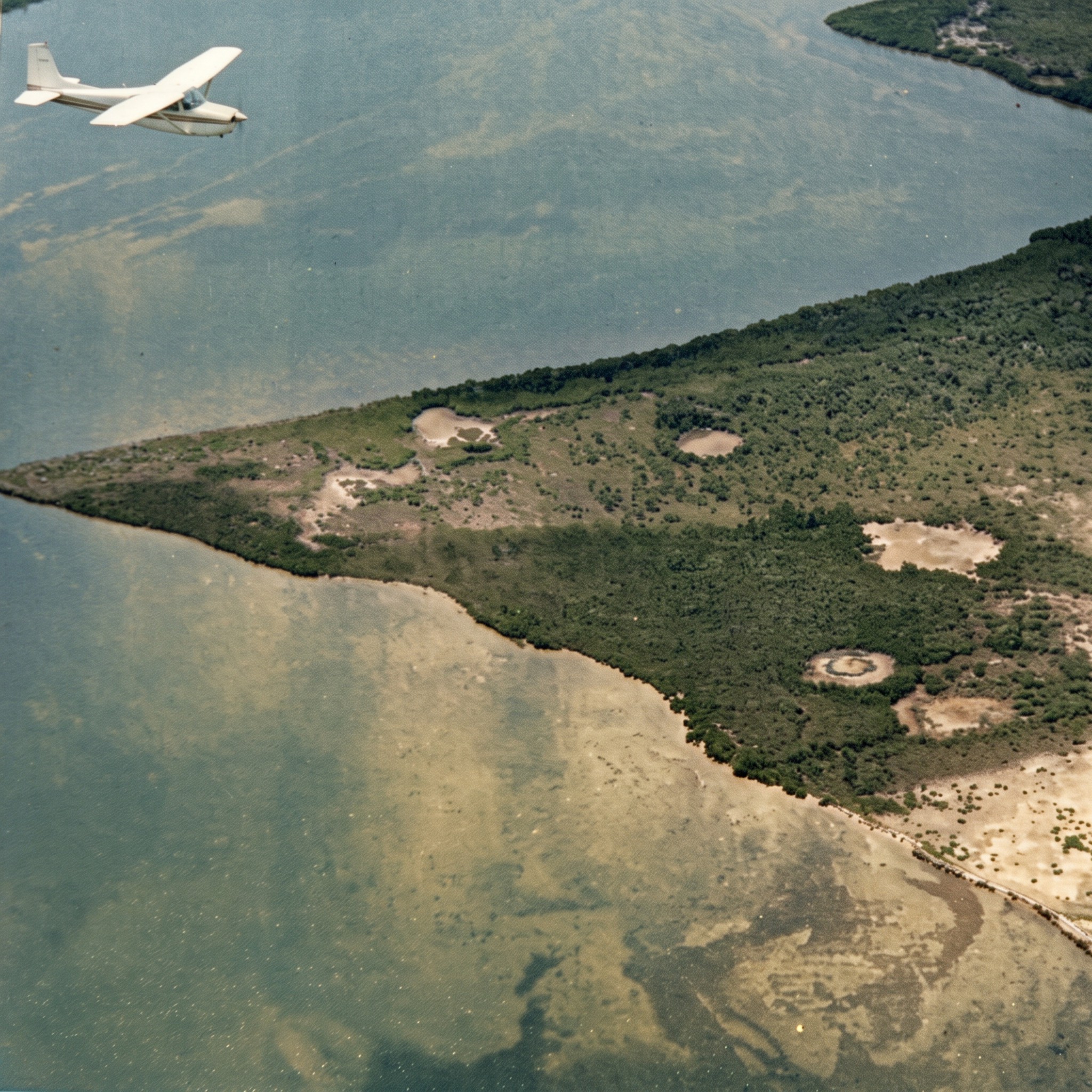
Photo: A small plane over the wild tip of Redfish Point in 1957, before any canals were dug. Restored and colorized from Lies That Came True by Eileen Bernard. Colors are added digitally.
Redfish Point
The point of land was known as Redfish Point, named for the fish that drew anglers to the river. It was low, flat country of pine, palmetto and scrub along the Caloosahatchee, with mangroves at the water.
People had used this coast for a very long time. The Calusa, the Native people of Southwest Florida, are believed to have dug a canoe canal across the peninsula, from Matlacha Pass to Yellow Fever Creek, long before any developer arrived. For how the modern canals came later, see why Cape Coral has so many canals.
A game reserve and open land
In the years before the city, the tract was held as private land and, by one local account, used as a game reserve. The wider region was ranch and scrub country, the kind of open land common in Lee County in the 1950s.
The book adds that survey crews later camped in the mangroves to lay out the first lots, dealing with heat, insects and wildlife. The earliest work was hard, with rough roads, snakes and bugs for the first residents, and the pioneers pushed through.
Who owned it before Gulf American
A 2017 history of the city says the sellers were Granville Keller and Frank Miles, and that the land was tied to Charles F. Miles of Miles Laboratories in Elkhart, Indiana, the company known for Alka-Seltzer, and to Ogden Phipps of New York.
The buying group became Gulf Guaranty Land and Title Company, led by the brothers Leonard and Jack Rosen, and later took the name Gulf American. For how they found the place, see who founded Cape Coral.
The 1957 purchase and the first work
Every source we checked gives the purchase price as $678,000. Sources differ on the size of that first tract, from about 1,100 acres to about 2,000, so we do not state one number. The company’s holdings grew much larger over the following years.
Ground was broken at Redfish Point on November 4, 1957. By April 1958 the first yacht basin had been dug and walled, the first roads were cut, and the construction payroll reached about 150 workers. From there, a city rose out of the scrub.
Cape Coral before the canals FAQ
What was Cape Coral before it was built?
A wild point of pine, palmetto and mangrove on the Caloosahatchee River, known as Redfish Point, held as private land and in part as a game reserve.
What was the land called?
Redfish Point, named for the fish that drew anglers to the river.
Who owned the land before Gulf American?
A 2017 history names sellers Granville Keller and Frank Miles, with ties to Charles F. Miles of Miles Laboratories and Ogden Phipps of New York.
How much did the land sell for in 1957?
$678,000, a figure every source agrees on. Sources differ on the acreage, from about 1,100 to about 2,000 acres.
When did building start?
Ground was broken at Redfish Point on November 4, 1957, and the first yacht basin was dug by April 1958.
Sources
- Captiva and Sanibel Island Sun, Cape Coral, a dream taking shape
- Cape Coral Breeze, Cape Coral’s 50th anniversary
- Wikipedia, Cape Coral, Florida
- Eileen Bernard, Lies That Came True (book)
Eileen Bernard worked in Gulf American’s publicity department, so her book is an insider’s account of Cape Coral’s early years. We use it alongside the other sources listed here.
Brenton Miebach, REALTOR®
Southwest Florida Lifestyle Living, eXp Realty. Helping buyers and sellers in Cape Coral, Fort Myers and Estero. Call or text 239-990-7738 or email brenton@brentonmiebach.com.
Next step
Curious about Cape Coral today?
Our Cape Coral area guide covers the neighborhoods, the water and what living here is like.
Explore Cape Coral